



LED Underwater Lights: Lighting Solutions for Enhancing Swimming Pools
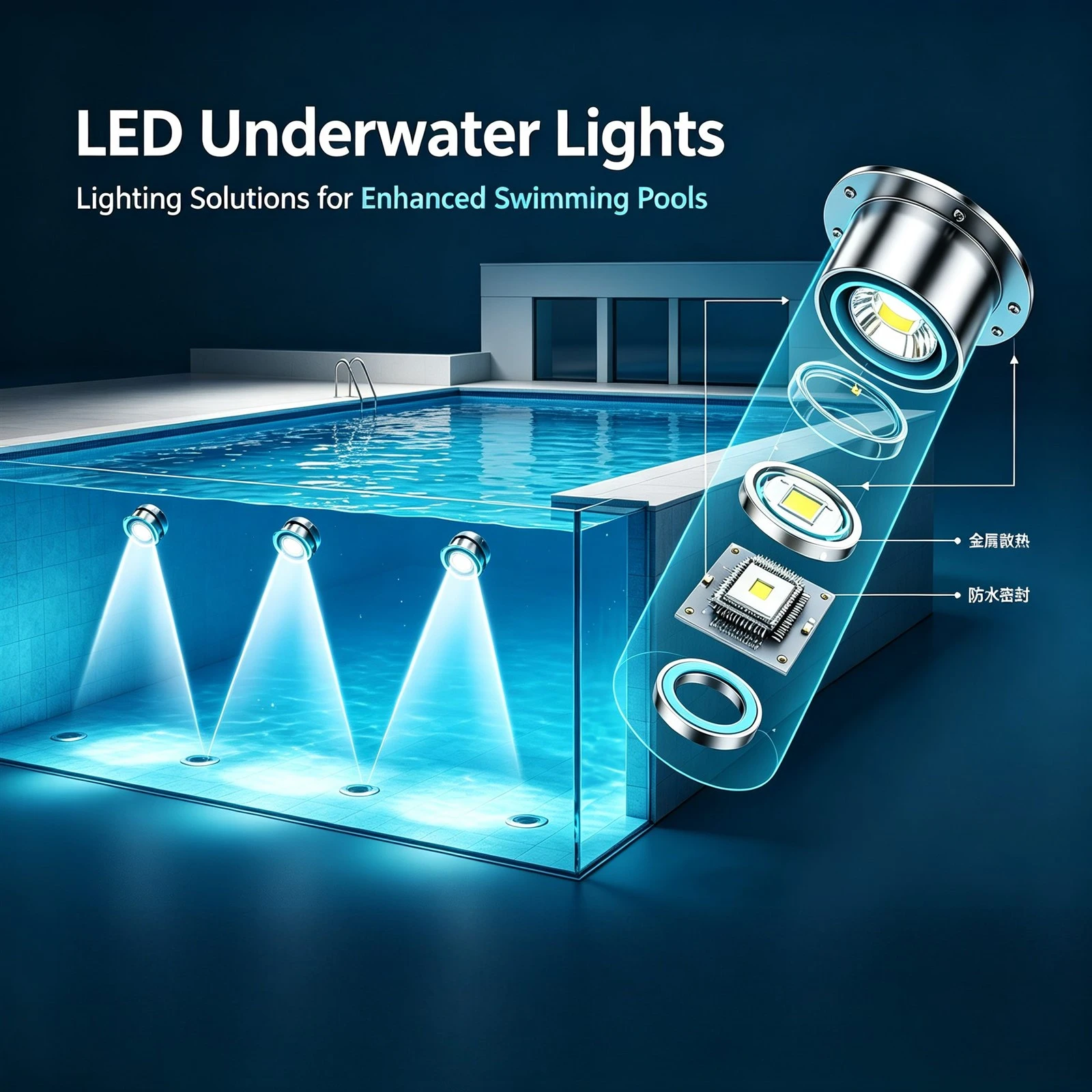
LED underwater lights are lighting devices installed within swimming pools that utilize electrical energy to drive light-emitting diodes (LEDs) to produce visible light. Their primary function is to convert electrical energy into light radiation within specific wavelengths and to facilitate the directional or diffuse propagation of light in an underwater environment. From the perspective of physical optics, these devices must address the phenomena of refraction, absorption, and scattering that occur as light travels through water. Water has a refractive index of approximately 1.33-higher than that of air-causing light to refract as it exits the fixture and altering its propagation path compared to air. Water also exhibits selective absorption of light waves; the attenuation rates differ between long-wavelength red light and short-wavelength blue light, a factor that directly influences the fixture's spectral design and effective illumination range.
To ensure safe underwater illumination, these fixtures feature a multifaceted physical structure comprising a sealed pressure-resistant housing, optical lenses, and thermal management components. The sealed housing is typically constructed from stainless steel or engineering plastics; it is either filled with waterproof gel or sealed using multi-layer O-rings to withstand hydrostatic pressure and prevent water ingress. Beyond protecting the light source, the optical lens plays a crucial role in controlling the beam angle, utilizing micro-prisms or diffusing materials to shape the light output. Thermal management relies on metal substrates and the housing itself to conduct heat away from the LED chips, thereby preventing accelerated light degradation or component failure caused by heat accumulation. Structural design adheres to Pascal's principle, ensuring that pressure at various depths is evenly distributed across the housing joints.
The conversion of electrical energy into light energy relies on the physical properties of semiconductors. When an electric current passes through the LED chip's p-n junction, the recombination of electrons and holes releases energy, a portion of which is radiated as photons. Underwater lights typically generate white light by using a blue LED chip to excite a yellow phosphor, or they employ a combination of multi-colored chips to produce dynamic color effects. The driving circuitry converts alternating current (AC) into low-voltage direct current (DC) and maintains a constant current to prevent flickering. Advanced models may integrate microcontrollers for programmable adjustment of light intensity and color sequences; signal transmission is achieved via waterproof bus systems or wireless radio frequency (RF) links, with the latter requiring solutions to overcome the attenuation of electromagnetic waves by water.
The optical performance of the fixture can be quantified using photometric parameters. Luminous flux describes the total light output, measured in lumens; illuminance represents the luminous flux received per unit area, measured in lux, with values decaying exponentially as water depth increases. Color temperature determines the "coolness" or "warmth" of the light; pool lighting typically employs neutral white light (4000–6000K) to ensure accurate color rendering. The Color Rendering Index (CRI) measures a light source's ability to reveal the true colors of objects; high-quality underwater lights require a CRI greater than 80. Together, these parameters determine whether the lighting effect meets the requirements for visual comfort.
Installation and configuration must adhere to principles of fluid dynamics and lighting engineering. Fixture spacing should ensure illuminance uniformity, avoiding alternating light and dark "zebra stripes." Fixtures near water jets must be positioned away from turbulent zones to prevent air bubbles from adhering to the lens and causing light scattering. Narrow-beam fixtures are preferred for deep-water areas to achieve vertical penetration, while wide-beam fixtures are suitable for shallow areas to provide diffuse lighting. Waterproof sleeves must be used where cables pass through pool walls, followed by watertightness testing; conduit routing should parallel the pool floor profile to minimize hydrodynamic drag.
From a materials chemistry perspective, long-term submersion imposes specific requirements on fixture materials. Housings must withstand chloride ion corrosion and UV-induced aging; since standard 316 stainless steel can still suffer pitting corrosion in chlorinated water, premium models utilize titanium alloys or ceramic coatings. Sealing materials must retain long-term elasticity; silicone rubber is widely used due to its ability to maintain flexibility across a broad temperature range. Lens materials must not only offer high light transmittance but also resist limescale buildup; some products feature a titanium dioxide photocatalytic coating that decomposes organic deposits via UV light.
Maintenance essentially involves monitoring and adjusting the state of the lighting system. Periodic inspections should include insulation resistance testing to ensure the resistance between the power supply and the housing exceeds 2 megohms. Monitoring for lumen depreciation involves comparing current output against initial illuminance values; an annual decay rate exceeding 20% typically indicates a failure in the heat dissipation system. Cleaning operations require the use of mild acidic solutions to dissolve calcium carbonate scale, while avoiding the use of hard objects that could scratch optical surfaces. Preventive replacement should be carried out immediately if the luminaire's sealing ring exhibits permanent compression deformation exceeding 15% or if the cable sheath shows signs of hardening and cracking.
The evolution of such lighting systems reflects the convergence of multidisciplinary technologies. Intelligent control modules are now integrating water quality monitoring probes to adjust disinfectant dosage based on optical signal feedback. Novel inorganic fluorescent materials have boosted luminous efficacy to over 200 lumens per watt while producing a spectrum that more closely resembles natural light. Wireless power transfer technology utilizes induction coils embedded in the pool wall to transmit electricity, thereby completely eliminating the risk of leakage associated with cable penetrations. Collectively, these technological advancements point toward more efficient and reliable underwater lighting solutions, with their development trajectory keeping pace with progress in fundamental physics and materials science.