



LED Pool Lights: An Energy Efficient Choice to Illuminate the Aquatic World
As swimming pools evolve from simple venues for swimming into spaces for leisure, entertainment, and aesthetic appeal, the importance of pool lighting has grown significantly. Particularly in hotels, villas, resorts, commercial facilities, and private residences, a well chosen lighting system is crucial not only for safety during night time use but also for the visual impact of the entire pool area.
Among the various pool lighting products available, LED pool lights are increasingly replacing traditional halogen lights as the preferred choice in the market, thanks to their low energy consumption, long lifespan, excellent waterproofing, and diverse lighting effects.
Why Are LED Pool Lights Becoming So Popular?
While traditional halogen pool lights offer high brightness, they present notable drawbacks regarding energy consumption, heat generation, and bulb longevity during prolonged use. For hotels, commercial pools, and large scale projects requiring extended daily illumination, ongoing electricity and maintenance costs are significant considerations.
LED pool lights utilize LEDs as their primary light source, typically offering substantial energy savings for the same level of illumination. Compared to traditional halogen lights, LED solutions can reduce energy consumption by approximately 80% and offer a significantly longer lifespan; high quality LED light sources can last for tens of thousands of hours.
This means pool operators do not need to replace bulbs frequently, thereby reducing long term maintenance requirements. This advantage is particularly pronounced for large scale pool projects that may require the installation of dozens or even hundreds of lights.
Beyond energy efficiency, LED light sources generate relatively little heat; unlike traditional high power fixtures, they do not reach excessively high temperatures during prolonged operation. This is a practical advantage given the unique, wet environment in which pool lights operate.
Waterproofing: A Critical Feature for Pool Lights
One of the primary differences between pool lights and standard indoor lighting is that pool lights operate in environments characterized by constant moisture or even total submersion. Consequently, when selecting pool lights, one cannot focus solely on brightness and aesthetics; waterproofing performance is equally vital.
High quality LED pool lights typically feature sealed designs and meet specific waterproofing standards based on their engineering. For instance, fixtures with an IP68 rating are capable of withstanding long term submersion.
The materials used for the light housing also influence the product's lifespan. Common materials found on the market today include polycarbonate (PC), ABS plastic, and stainless steel. For saltwater pools or pools where water treatment chemicals are frequently used, particular attention should be paid to the corrosion resistance of the light housing, screws, and other metal components.
When purchasing LED pool lights, contractors and equipment distributors are advised to verify specifications such as the waterproof rating, materials, operating voltage, sealing method, and suitability for the specific water environment, rather than making a decision based solely on price.
Diverse lighting effects transform the pool from a mere source of illumination into something more.
The functionality of modern pool lights extends far beyond providing basic illumination.
While traditional white light meets standard needs for swimming and safety, RGB or RGBW LED pool lights can create entirely different atmospheres through various color combinations.
For instance, hotel pools can use blue or cyan lighting to create a crisp, upscale visual effect; villa pools can switch colors to suit gatherings, holidays, or evening relaxation; and commercial pools or resorts can utilize dynamic lighting effects to enhance the overall appeal of the space.
Some smart LED pool lights also support control via remote, WiFi, or mobile apps, allowing users to adjust light color, brightness, and modes directly without needing to operate the controls on site.
For modern smart home and smart pool projects, these features make it easier to integrate pool lighting into a comprehensive smart control system.
How should you choose LED pool lights?
Pool structures and usage requirements vary, so not every LED pool light is suitable for every application.
First, determine the installation method. Common product types include wall mounted, recessed, and nicheless pool lights. For new pools, installation locations can be planned during the design phase; for pool renovations, it is often best to prioritize products that offer flexible installation options to minimize alterations to the existing structure.
Second, verify the voltage requirements. Swimming pools are specialized environments where low voltage power supply solutions are generally more suitable. Since electrical standards differ across countries and regions, export projects require advance confirmation that the operating voltage and compatible transformers comply with local regulations.
Finally, select the appropriate wattage and quantity based on the pool's dimensions. Small private pools do not necessarily require high wattage lights, whereas large commercial pools require comprehensive planning based on length, width, depth, and desired lighting effects. To achieve uniform illumination, one must also consider the spacing between fixtures and their coverage area. Simply adding more lights does not necessarily yield better results; a well planned layout is often more important than merely increasing wattage.
What should be considered when installing LED pool lights?
Although installing some LED pool lights is straightforward, the process involves both water and electricity-two critical factors-so it must be carried out in strict accordance with product instructions and local electrical codes.
Before installation, ensure the power supply is completely turned off and verify that the power lines, transformers, and wiring connections meet requirements. Once the lights are connected, carefully inspect the wiring points and seals to prevent moisture from entering the light housing or electrical connections.
For projects involving the replacement of old pool lights, confirm that the new fixtures are compatible with the existing mounting bases, brackets, and wiring. If dimensions differ, verifying mounting hole locations and bracket specifications beforehand can prevent the need for on site rework.
For professional projects, installation and electrical inspections should be performed by qualified and experienced personnel. This is especially important for large commercial, hotel, and public pools, where installation and final inspection must comply with local safety standards.
LED pool lights: More than just illumination-an integral part of pool design
The right pool light can dramatically transform the visual appeal of a pool at night.
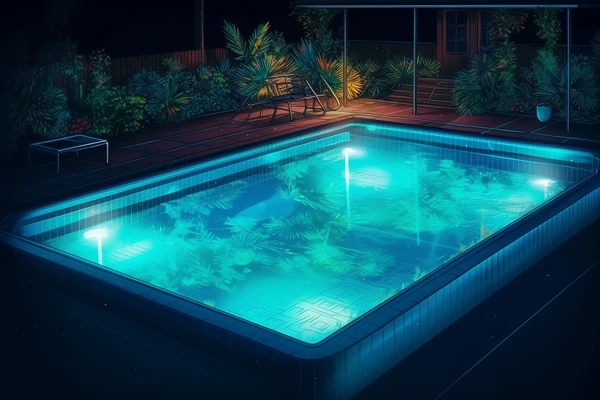
During the day, the pool relies largely on natural light to showcase the water and surrounding landscape; at night, lighting becomes a key element of the entire space. Light reflecting off the water creates natural plays of light and shadow. When combined with surrounding garden, wall, or landscape lights, the pool lighting helps create a cohesive visual effect that unifies the pool with the broader outdoor area.
Therefore, when designing a pool project, LED pool lights should not be viewed merely as functional equipment; instead, they should be considered alongside the pool structure, surrounding landscape, and overall design style.
For hotels, guesthouses, and resorts, excellent pool lighting can serve as a major visual draw for guests. For private pools, it can transform an ordinary outdoor space into an area with a completely different atmosphere at night. Long term Costs Are Equally Important for Pool Projects
When purchasing pool lights, unit price is often the first factor clients consider; however, for B2B clients, the total cost of ownership over the product's entire lifecycle is far more significant.
A low priced pool light with a short lifespan and unstable waterproofing may require frequent replacement, ultimately resulting in higher labor and maintenance costs.
In contrast, while high quality LED pool lights-featuring reliability, longevity, and robust sealing-may have a slightly higher initial purchase price, they reduce costs associated with repairs, replacements, and labor over the long term.
For pool contractors, wholesalers, and distributors, factors such as product stability, after sales support, spare parts availability, and customization capabilities are equally critical when selecting a supplier.
Future Trends in LED Pool Lighting
As LED technology, smart control systems, and pool equipment continue to evolve, the future of pool lighting will increasingly focus on energy efficiency, intelligence, and system integration.
Moving beyond simple white light to RGB color changing capabilities-and incorporating WiFi, app, and voice controls, as well as integration with smart pool systems-LED pool lights are transforming from standalone lighting products into integral components of smart pool ecosystems.
For pool equipment suppliers, future competition will not hinge merely on brightness; success will depend on product stability, ease of control, simplicity of installation, and the ability to meet customization needs across diverse markets and projects.
Conclusion
Thanks to their energy efficiency, longevity, waterproofing, corrosion resistance, and diverse lighting effects, LED pool lights have become a premier choice for modern pool illumination. Whether for private residential pools, hotel pools, commercial facilities, or large scale landscape projects, suitable LED lighting solutions can be selected to meet specific requirements.
When purchasing pool lights, buyers and contractors should look beyond price and comprehensively evaluate factors such as waterproof ratings, materials, light source lifespan, operating voltage, installation methods, control features, and the supplier's after sales service.
A truly reliable pool lighting system not only enhances safety and visibility at night but also elevates the overall quality and user experience of the space through thoughtful lighting design. Driven by ongoing advancements in smart technology and energy efficiency, LED pool lights will continue to play a pivotal role in the pool lighting market.