



Swimming Pool Light Producer: What Makes a Professional Manufacturer Different?
1. Introduction: The Critical Difference Between a Product Seller and an Experienced Manufacturer
In the global swimming pool supply industry, nearly any trading company can set up a storefront, publish a glossy catalog, and quote attractive unit prices for underwater luminaires. To an inexperienced purchasing agent, these product offerings can appear virtually identical: similar round faceplates, waterproof claims, and comparable wattage ratings.
However, seasoned procurement directors and commercial pool contractors know that what happens beneath the water line tells a completely different story. A commercial seller simply acts as an intermediary, moving finished boxes without understanding the underlying electro-mechanical challenges of submersible lighting. When field failures occur-such as moisture condensation inside the lens, rapid lumen decay after one season, or unsynchronized RGB color switching-a product reseller can do little more than forward email complaints back and forth.
In contrast, an experienced swimming pool light producer is an engineering-driven enterprise. A professional manufacturer owns the complete lifecycle of the product: from optical beam modeling and thermal dissipation simulations to precision CNC machining, automated resin encapsulation, and multi-stage hydrostatic pressure testing. Understanding what truly makes a dedicated manufacturing partner different is the most powerful safeguard an international buyer has against costly warranty claims and damaged brand equity.
2. What Does a Professional Swimming Pool Light Producer Actually Do?
Underwater lighting exists at the demanding intersection of optoelectronics, fluid mechanics, hermetic sealing chemistry, and high-voltage electrical safety standards. A dedicated pool light manufacturer does far more than assemble components on a bench. Its core responsibilities span four primary domains:
Thermal & Electrical Circuit Engineering: Submersible luminaires must dissipate heat into surrounding pool water without air venting. A professional producer designs multi-layer Metal Core PCBs (MCPCB), integrates constant-current driver circuits with thermal foldback protection, and simulates thermal dissipation to prevent LED junction overheating.
Specialized Underwater Optical Simulation: Water refracts light at an index of ~1.33 (compared to 1.0 in air). A specialized manufacturer designs custom secondary optical lenses and diffusers that distribute light evenly across the pool floor while preventing upward glare and localized hot spots.
Material Metallurgy & Polymer Chemistry: The producer selects, formulates, and tests raw materials-including marine-grade 316L stainless steel, anti-UV polycarbonate polymers, and modified polyurethane or epoxy potting resins-specifically to withstand aggressive pool chemicals, chlorine shock treatments, and salt-water electrolysis.
Closed-Loop Quality Control & Traceability: The factory maintains rigorous quality management systems that trace raw components from incoming inspection (IQC) through automated SMT assembly, resin curing, 100% submerged aging, and final hydrostatic pressure verification (OQC).
3. Product Engineering vs. Simple Assembly: The Hidden Reality
The difference between an engineering-driven LED pool light factory and a low-tier manual workshop is stark when examining internal construction:
|
Engineering Dimension |
Generic Assembler / Trading Source |
Professional Swimming Pool Light Producer |
|
Driver Architecture |
Generic constant-voltage (CV) boards; no thermal protection |
Custom constant-current (CC) drivers with thermal foldback & surge suppression |
|
Waterproof Sealing |
Manual silicone gluing; prone to uneven bead thickness and micro-gaps |
Automated resin-filling lines with vacuum de-airing or multi-ridge compression gaskets |
|
Optical Control |
Flat transparent plastic cover; severe hot spots and glare |
Custom-engineered optical lenses and micro-prismatic diffusers designed for water refraction |
|
Cable Termination |
Standard cable gland tightened manually; vulnerable to water wicking |
Sub-potted anti-siphon blocks sealing individual copper conductors into resin |
|
Submerged Burn-In |
Brief dry bench flash test (few minutes); no water aging |
100% 12-to-24 hour continuous submerged aging under power with thermal shock switching |
|
Certifications |
Generic CE declaration; often lacks model-specific test reports |
Model-specific CE (LVD/EMC), RoHS, FCC, and IP68 reports from accredited third-party labs |
4. Different Types of Pool Lighting Technology and Architectural Form Factors
A versatile LED underwater lighting manufacturer provides comprehensive product options tailored to regional pool construction methods and commercial project specifications:
1. Surface Wall-Mounted Pool Lights
Designed for straightforward installation on concrete, fiberglass, or vinyl liner pool walls without requiring a pre-installed niche cavity. Modern professional units feature ultra-slim profiles (<25mm thickness) with hydrodynamic beveled bezels, preventing swimmers from snagging clothing or using the luminaire as a step.
2. Nicheless & Mini Underwater Lights
Engineered for 1.5-inch or 2-inch standard wall inlets, these compact fixtures are increasingly specified by architects for spa steps, baja shelves, sun ledges, and residential swim spas where subtle, distributed accent lighting is preferred over large floodlights.
3. Universal PAR56 Retrofit Replacement Lamps
Serving the massive global pool renovation market, professional producers manufacture sealed LED PAR56 retrofits designed to replace energy-intensive 300W traditional halogen sealed-beam bulbs inside existing European and American standard niches, operating on standard 12V AC pool transformers.
4. Heavy-Duty Commercial Stainless Steel & Fountain Fixtures
For hotel aquatic centers, public competition pools, and municipal water features, heavy-gauge 316L stainless steel luminaires with thick tempered glass lenses deliver high lumen output (35W to 100W+) and maximum mechanical impact resistance (IK08/IK10).
5. Material Selection: PC, Stainless Steel 316L, and Housing Options
Selecting the right housing material is a critical engineering decision dictated by pool water chemistry and environmental conditions:
AISI 316 / 316L Stainless Steel: Marine grade (low carbon). The gold standard for metal pool lighting. The inclusion of 2-3% molybdenum provides exceptional resistance against chloride pitting and crevice corrosion in standard chlorinated pools and modern salt-chlorination systems (operating at 3,000–5,000 ppm salt TDS).
304 Stainless Steel (The Pitfall to Avoid): Highly susceptible to rapid pitting corrosion and rust stains in chlorinated and salt-water pools. Professional pool lighting manufacturers avoid 304 stainless steel for submerged applications.
Engineering Polycarbonate (PC) & ABS: Engineered with specialized anti-UV and antioxidant additives to prevent yellowing, micro-cracking, and embrittlement under intense tropical UV radiation and chemical shock treatments.
Full Resin-Encapsulated Unibody: Solid-cast modified polyurethane or epoxy resin structures that eliminate internal air chambers entirely, creating an impervious barrier against chemical corrosion, water pressure, and mechanical vibration.
|
📌 MATERIAL SELECTION TIP |
6. Waterproof Design and Electrical Safety Standards
Underwater electrical safety is non-negotiable. An experienced pool light production company enforces strict compliance with international safety codes and waterproof engineering:
Understanding Authentic IP68 Protection
Under IEC 60529, IP68 mandates continuous submersion under specified pressure conditions. A professional producer specifies exact testing parameters-such as continuous operation at 2 to 10 meters depth (0.2 to 1.0 bar pressure). Crucially, testing must be conducted dynamically while the luminaire is powered on and off, inducing thermal expansion and contraction cycles that challenge mechanical seals.
Low-Voltage Electrical Safety & Isolation
Submersible pool lights operate on Safety Extra-Low Voltage (SELV)-typically 12V AC, 12V DC, or 24V DC. Professional manufacturers design internal drivers with galvanic isolation, short-circuit protection, and electromagnetic compatibility (EMC) compliance to ensure the light generates zero electrical noise that could interfere with sensitive pool pumps, chemical sensors, or chlorinators.
7. Manufacturing Consistency and Quality Management Systems
Consistency across production batches is what separates a world-class factory from an inconsistent workshop. A disciplined quality assurance framework includes:
1. Incoming Quality Control (IQC): Spectroradiometer testing for LED color temperature (CCT) consistency, optical forward voltage ($V_f$) binning, and chemical alloy spectrometer verification for stainless steel raw stock.
2. In-Process Quality Control (IPQC): Automated Optical Inspection (AOI) on SMT pick-and-place lines, continuous resin potting weight verification, and torque-controlled assembly fixtures.
3. 100% Submerged Aging (FQC): 100% of finished luminaires must complete 12 to 24 hours of continuous submerged electrical burn-in testing in dedicated aging water tanks, interspersed with rapid ON/OFF thermal shock switching.
4. Outgoing Quality Control (OQC): Random AQL lot sampling for hydrostatic pressure chamber testing at 2–5 bar pressure, salt-spray corrosion tests (ASTM B117), cable pull-strength validation, and drop-tested packaging checks.
8. HOTOOK's Development in the LED Pool Lighting Industry Since 2006
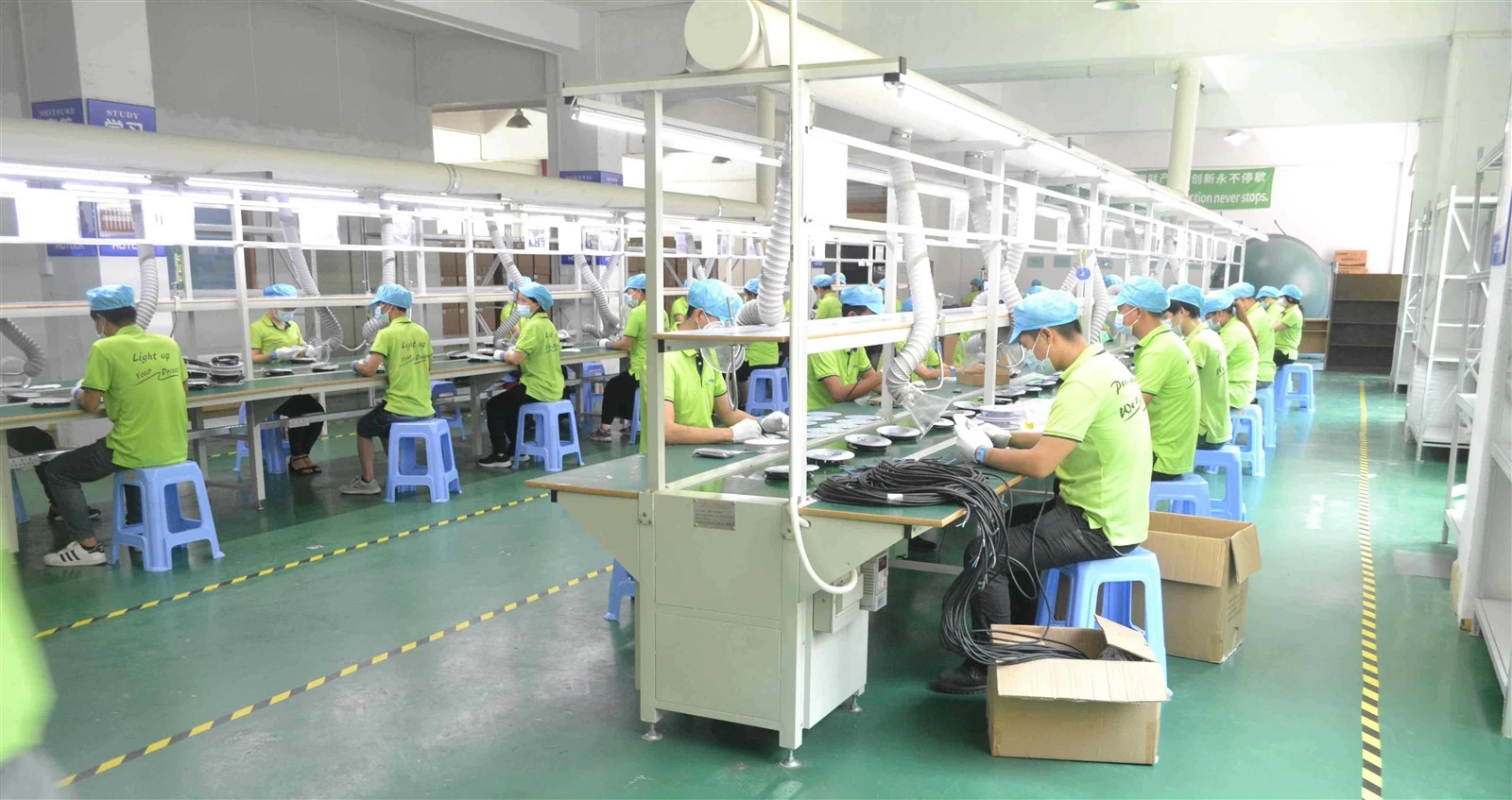
Established in 2006, HOTOOK has accumulated two decades of focused manufacturing experience in LED underwater lighting and swimming pool equipment solutions. Over years of dedicated production and engineering refinement, HOTOOK has established itself as a reliable manufacturing partner for international distributors, wholesalers, and project contractors.
Dedicated In-House Manufacturing Infrastructure
HOTOOK's production facility integrates a complete suite of specialized machinery and testing apparatus:
CNC Machining Centers: High-precision multi-axis CNC milling centers for precision machining of 316L stainless steel bezels, brackets, and fountain fittings.
Resin Filling Equipment: Automated two-component resin dispensing equipment delivering bubble-free polyurethane and epoxy encapsulation.
Vacuum Degassing Systems: Industrial vacuum de-airing equipment that eliminates internal micro-voids during potting.
Laser Marking Equipment: Fiber laser marking machines for permanent rating plate engravings, barcode tracking, and custom private-label branding.
IP68 Waterproof Testing Vessels: Multi-station hydrostatic pressure test vessels simulating deep underwater installation conditions.
Comprehensive Product Portfolio & One-Stop Solutions
HOTOOK's product portfolio covers the full spectrum of swimming pool lighting: surface wall-mounted luminaires, ultra-slim resin-filled pool lights, compact nicheless lights, universal PAR56 retrofit lamps, and synchronized multi-light RGB/RGBW systems. Backed by comprehensive OEM/ODM customization capabilities, HOTOOK supports global clients with customized optical designs, private branding, tailored cable specifications, and complete one-stop swimming pool equipment solutions.
9. How Manufacturers Support International Distributors and Wholesalers
A strategic manufacturing partner does more than supply products; they empower their distributors to capture regional market share through dedicated commercial and technical support:
1. Technical Tender & Engineering Support: Experienced manufacturers maintain dedicated sales and engineering teams that provide rapid turnaround on project quotations, IES photometric files, wiring schematics, and commercial project tenders.
2. Private-Label & Marketing Coordination: Supporting distributors with full OEM private-label branding, customized color gift boxes, contractor installation manuals, and multi-lingual marketing collateral.
3. Regulatory & Certification Assistance: Assisting importers with regional compliance documentation, accredited third-party test reports (CE, RoHS, IP68, FCC), and certificates of origin for customs clearance.
4. Reliable Production Scheduling & Supply Chain Security: Delivering predictable lead times, transparent MOQ schedules, and reliable spare parts support to keep distributor supply chains running smoothly.
10. Conclusion and Frequently Asked Questions (FAQs)
In the competitive swimming pool industry, partnering with a genuine, engineering-driven swimming pool light producer is the foundation of sustainable commercial success. By looking beyond superficial unit pricing and demanding verified in-house machinery, authentic IP68 hydrostatic pressure testing, and multi-stage quality control, global buyers protect their bottom line, satisfy contractors, and build enduring brand value.
|
📌 START YOUR B2B PARTNERSHIP WITH HOTOOK |
Q1: What is the main operational difference between a pool light manufacturer and a trading company?
A manufacturer owns the physical production machinery (CNC tools, automated resin-filling lines, hydrostatic testing vessels), employs dedicated R&D engineers, and directly controls quality from raw material to finished product. A trading company acts as an intermediary, purchasing from third-party factories without direct control over engineering, quality consistency, or component traceability.
Q2: Why is automated resin filling superior to manual silicone sealing in pool lights?
Manual silicone sealing relies on hand-applied glue beads, which can vary in thickness and trap air pockets, leading to seal failure under hydrostatic pressure. Automated resin encapsulation dispenses precisely mixed, vacuum-degassed resin that cures into a solid, void-free block, completely isolating electronic components from water ingress and chemical exposure.
Q3: Which stainless steel grade should buyers specify for salt-water swimming pools?
Always specify AISI 316 or 316L (marine grade) stainless steel for salt-water pools. Grade 304 stainless steel lacks sufficient molybdenum and will suffer severe pitting and rust staining when exposed to the high chloride levels generated by salt-chlorination systems (3,000–5,000 ppm TDS). Full resin-filled polymer bodies are also an outstanding corrosion-proof alternative.
Q4: How do professional manufacturers ensure that all RGB lights synchronize properly?
Manufacturers utilize synchronous 2-wire AC switch control with internal non-volatile memory, external DMX512 / RS485 communication protocols, or synchronized 4-wire DC controller systems. These engineering designs ensure that all pool lights on the same circuit cycle through color modes simultaneously without drifting out of sync over time.
Q5: What should global buyers look for in a factory's waterproof testing process?
Buyers should verify that the factory utilizes pressurized hydrostatic testing chambers (capable of simulating 2 to 10+ meters of depth) and conducts 100% submerged electrical aging under continuous power with rapid ON/OFF thermal shock switching, rather than brief dry bench tests or shallow unpressurized water dips.
Q6: What customization options are typically available for OEM private-label projects?
Standard OEM customization includes laser-marked logos, custom cable lengths (from 2m up to 50m with submersible rubber jackets), specific CCT selections (3000K, 4000K, 6000K, royal blue, RGB/RGBW), custom retail packaging with barcoding, and specialized mounting bracket configurations for concrete, liner, or fiberglass pools.