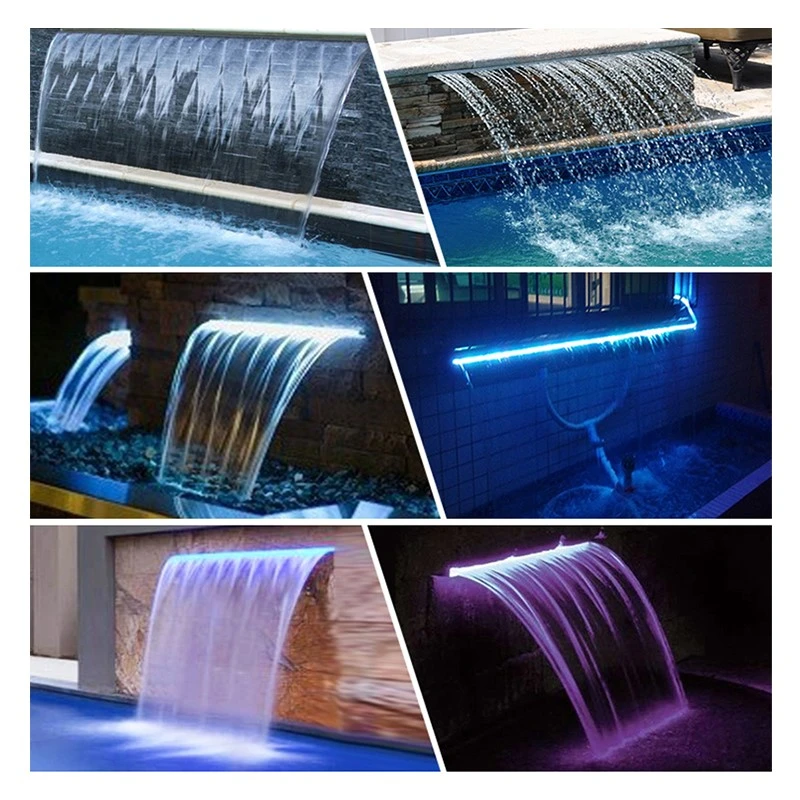


How to Choose the Right Size Pool Waterfall for Your Pool
A pool waterfall is one of the few upgrades that changes how a pool feels the moment it's turned on - the sound alone does more for a backyard than most decking or lighting packages ever will. But sizing a swimming pool waterfall wrong is one of the most common (and most expensive) mistakes homeowners and pool builders make. Go too small and the feature dribbles instead of falling; go too big and you're stuck with an underpowered pump, a noisy overflow, or a monthly energy bill nobody planned for.
This guide breaks down how pool professionals actually size a water curtain or water descent feature - using real flow rate and plumbing data instead of guesswork - so you can pick a waterfall that matches your pool, your pump, and your budget.
Water Curtain vs. Water Descent: Know What You're Sizing
Before you can size a waterfall correctly, you need to know which type you're installing, because the flow rate math is different for each.
Water curtain / sheet waterfall (sometimes called an "original" or "sheer" falls unit): Water flows over a fixed lip and falls in a continuous sheet directly against the wall or a short distance out. This is the classic backyard waterfall style and the easiest to size.
Water descent / sheer descent: A more architectural feature where water is projected off a raised wall or spillway edge so it falls in a clear, unbroken curtain with visible space (a "reveal") behind it. Water descents demand significantly more flow than a basic water curtain because the goal is a clean arc of water, not just a wet wall.
Rain or laminar features: Water is broken into multiple slim jets or a soft rain like texture. These generally need less flow per inch of width than either a curtain or a descent.
Mixing these categories up is where most sizing mistakes start - a pump sized for a simple water curtain will almost never push a proper water descent, no matter how good the plumbing is.
The Core Number: Flow Rate Per Inch of Width
The industry rule of thumb for a standard water curtain pool waterfall is close to 1 GPM (gallon per minute) of flow for every inch of spillway width. Manufacturer spec sheets for common backfeed waterfall units confirm this pattern closely:
|
Waterfall Width |
Typical Pump Requirement |
|
12 in. |
12 GPM |
|
18 in. |
18 GPM |
|
24 in. |
24 GPM |
|
48 in. |
48 GPM |
A water descent needs considerably more, because you're also fighting projection distance and wall height. Pool forums and plumbing references built around real installations put sheer descents at roughly 12 GPM per linear foot for a modest, close to the wall fall, climbing to 20 GPM per linear foot when the wall sits several feet above the water and you want a couple of feet of clean projection outward. In practical terms, a 5 foot wide water descent wall can realistically need anywhere from 60 to 100 GPM depending on how far you want the water to arc before it lands.
That's the number pool owners are almost always surprised by - a modest looking water descent can require double or triple the flow of a same width water curtain.
Matching Pump Size and Plumbing to the Waterfall
Once you know your target GPM, the pump and pipe have to be able to deliver it without excessive velocity, which causes noise, erosion inside the pipe, and premature fitting failure. As a rule, suction side plumbing should stay under about 6 ft/sec of water velocity, and pressure side (return) plumbing under about 8 ft/sec. Approximate maximum flow by pipe size looks like this:
|
Pipe Size |
Max Flow @ 6 ft/sec |
Max Flow @ 8 ft/sec |
|
1.5 in. |
38 GPM |
51 GPM |
|
2 in. |
63 GPM |
84 GPM |
|
2.5 in. |
90 GPM |
119 GPM |
|
3 in. |
138 GPM |
184 GPM |
|
4 in. |
235 GPM |
312 GPM |
If you're planning a large water descent (80–100+ GPM), a 2 inch line is already marginal, and most experienced pool builders will step up to 2.5 or 3 inch plumbing with a dedicated waterfall pump rather than trying to share flow off the main filtration pump. Undersized pipe is the single biggest reason a "big" waterfall ends up looking weak - the pump may be rated for enough GPM, but the plumbing chokes the flow before it ever reaches the spillway.
For a single small water curtain (12–24 inches), most standard variable speed pool pumps can run the feature off a secondary port. For anything approaching a multi foot water descent, plan on a separate waterfall pump - a 1.5 to 3 HP unit is typical for a single sheer descent wall in the 3 to 6 foot range.
Matching Waterfall Size to Pool Size
There's no strict formula tying pool size to waterfall width, but a few practical guidelines keep proportions looking right:
Small pools (under 400 sq ft): A single 12–24 inch water curtain is usually plenty - anything wider tends to dominate the water surface.
Mid size pools (400–800 sq ft): 24–48 inches of water curtain, or a 3–4 foot water descent, reads as proportionate without overwhelming the pump budget.
Larger pools (800+ sq ft) or resort style designs: Multiple water curtain sections, or a water descent spanning 5 feet or more, are common - but at this scale you're almost always running a dedicated pump loop rather than sharing the filtration system.
A good visual test: stand at the far end of the pool and imagine the waterfall running. If the falling water would cover less than roughly 10–15% of that wall's length, it will likely look undersized once it's actually installed and running rather than sketched on paper.
What It Actually Costs
Budget is often the real limiting factor in sizing decisions, so it helps to know real ranges rather than guessing. Installed pricing for pool water features varies widely by scope:
A basic water curtain feature (materials, pump, and plumbing) typically runs $1,000–$3,000 for smaller residential installs, with simple 12 square foot rock and basin style waterfalls averaging around $1,500.
A water descent or sheer descent wall, because of the taller wall structure, higher flow pump, and larger pipe, generally lands in the $3,000–$9,000 range for a single wall section, and can push toward $12,000–$40,000 for multi wall or fully custom architectural designs.
Retrofitting a waterfall onto an existing pool - rather than building it in during initial construction - adds cost for plumbing upgrades and electrical work, commonly bringing the total project to $4,000–$12,000 once pump sizing, controls, and permitting are factored in.
Oversizing a waterfall doesn't just cost more upfront - it raises ongoing electrical draw every time the feature runs, since GPM and pump horsepower scale together. Sizing to the pool and the intended visual effect, rather than to "as big as possible," keeps both the installation and the operating cost in check.
Common Sizing Mistakes to Avoid
Using water curtain math for a water descent. They are not interchangeable calculations - a descent needs roughly double the flow per foot.
Ignoring pipe velocity. A pump rated for enough GPM still won't deliver it through undersized plumbing.
Sharing flow with the main filtration pump on anything beyond a small water curtain - it starves both systems.
Skipping a flow control valve. Even a correctly sized system benefits from the ability to dial flow up or down for different times of day or noise levels.
FAQ: Sizing a Pool Waterfall
How many GPM do I need for a small water curtain waterfall?
For a standard backfeed water curtain, plan on roughly 1 GPM per inch of spillway width - a 12 inch unit needs about 12 GPM, an 18 inch unit about 18 GPM, and a 24 inch unit about 24 GPM.
Is a water descent more expensive to run than a water curtain?
Generally yes. Because a water descent needs 12–20 GPM per linear foot compared to roughly 1 GPM per inch for a curtain, the pump has to work harder, which increases both the equipment cost and the electricity used per hour of operation.
Can I run my waterfall off my existing pool pump?
For a small water curtain, often yes, if the pump has spare capacity and a dedicated port. For a water descent or any feature requiring 50+ GPM, a separate dedicated waterfall pump with its own plumbing run is the more reliable approach.
What pipe size do I need for a wider water descent?
As a starting point, a 2 inch line comfortably supports up to about 63–84 GPM depending on velocity limits. Anything beyond that - which covers most multi foot water descents - typically calls for 2.5 or 3 inch plumbing.
Does a bigger waterfall always look better?
Not necessarily. A waterfall sized to roughly 10–15% of the adjoining wall length, with flow matched correctly to its width, generally reads as more natural than an oversized feature running on an underpowered pump.